Skip to content

Why Choose an NTC Temperature Probe?

Choosing the right temperature sensor can shape an entire control system. An NTC Temperature Probe offers a practical balance of sensitivity, size, cost, and response speed. Its resistance decreases as temperature rises, creating a measurable electrical signal for monitoring equipment, appliances, vehicles, and industrial processes.

Physicist William Thomson, Lord Kelvin, famously said, “If you cannot measure it, you cannot improve it.” His statement still matters here. Reliable temperature data begins with a properly selected probe. Engineers must consider the temperature range, probe material, cable length, response time, and installation environment. A stainless-steel probe may suit a damp process line, while a compact epoxy-coated design can fit tightly packed electronics. Small details matter.

The choice is not automatically perfect. An NTC Temperature Probe can drift, react slowly inside heavy metal housings, or produce errors when wiring resistance is ignored. Calibration is essential. So is checking the sensor against a trusted reference at realistic operating points. That step is sometimes skipped, especially in low-cost projects. It should not be.

This article examines why many designers choose NTC technology for dependable temperature measurement. It also considers its limits. Practical performance depends on more than the thermistor itself. Signal conditioning, placement, insulation, and maintenance can change the final result. When these factors are handled carefully, an NTC Temperature Probe can deliver sensitive, repeatable readings without adding unnecessary complexity.
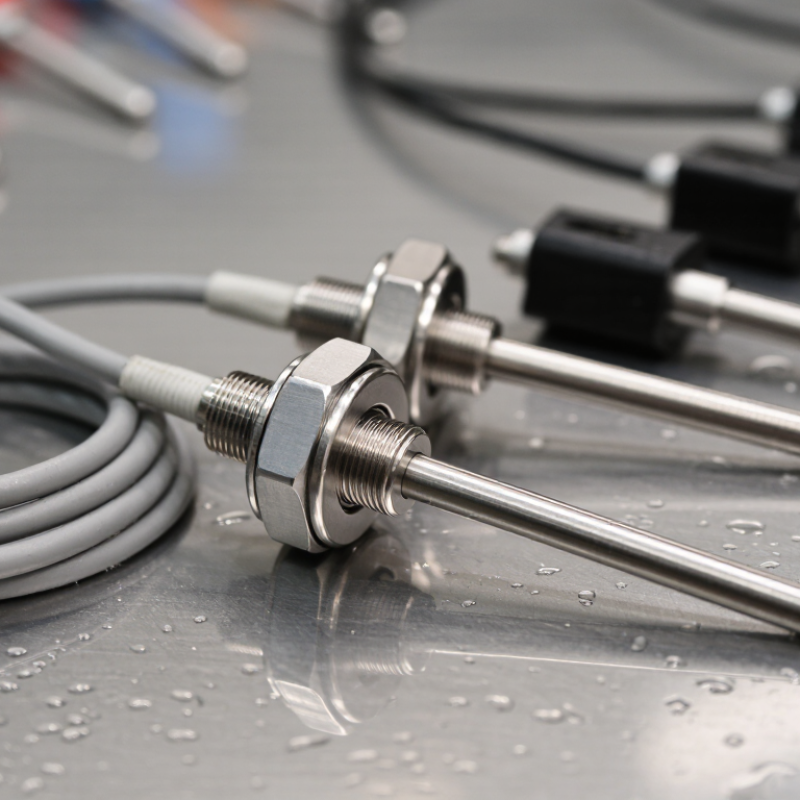
Why Choose an NTC Temperature Probe?

What Is an NTC Temperature Probe?

An NTC temperature probe is a sensor that measures temperature through changing electrical resistance. NTC means negative temperature coefficient. Its resistance decreases as the surrounding temperature rises. A measuring circuit reads this change and converts it into a temperature value. The sensing element is usually protected inside a metal, plastic, or glass probe. Simple, but useful.

Why choose an NTC probe? It offers fast response, compact construction, and good sensitivity across many everyday temperature ranges. In equipment checks, a probe can sit against a pipe, inside a tank, or near an airflow channel. The cable carries the signal to a controller, meter, or monitoring system. This makes installation practical in tight spaces. However, placement matters. A poorly positioned probe may read the surface instead of the actual fluid temperature.

Accuracy depends on more than the sensor itself. The resistance curve, wiring length, contact quality, and reading circuit all affect the result. Calibration against a trusted reference is sensible, especially when a few degrees matter. Moisture can also enter weak seals and create unstable readings. I have seen a clean-looking probe produce inconsistent data because its connector was loose. That detail is easy to miss. NTC probes are affordable and responsive, but they are not automatically precise. Correct selection and careful installation remain essential.

How Does NTC Thermistor Sensing Work?

An NTC temperature probe senses heat through a predictable electrical change. NTC means negative temperature coefficient. Its resistance falls as temperature rises. A measurement circuit sends a small, controlled current through the thermistor. The resulting voltage becomes a temperature estimate. In many designs, the probe forms a voltage divider with a fixed resistor. An analog-to-digital converter reads the divider voltage. Software then converts that reading using a resistance-temperature curve. The curve often uses a beta value or a Steinhart-Hart model.

Good sensing depends on more than the thermistor itself. Probe placement matters. A sensor touching a metal surface usually reacts faster than one suspended in air. Thermal paste can reduce contact gaps, but excess material may slow response. Cable length also introduces resistance and electrical noise. For accurate work, measure the probe at known reference points, such as an ice bath and a controlled warm bath. Record the actual resistance, not only the displayed temperature. That habit exposes wiring errors early.

Self-heating deserves attention. Even a small current can warm a tiny bead, especially in still air. Use low excitation and allow settling time between readings when necessary. The first prototype often assumes stable room temperature. That assumption can be wrong. Airflow, moisture, and nearby components can shift results. A reliable NTC system combines proper placement, calibration, filtering, and a realistic error budget. Test these details instead of guessing.

Which Advantages Make NTC Probes a Practical Choice?

NTC temperature probes are a practical choice when accurate, responsive temperature monitoring matters. Their resistance falls as temperature rises, allowing electronic systems to detect small thermal changes with simple measurement circuits. This behavior gives NTC probes strong sensitivity across many working ranges. They are also compact enough to fit inside narrow housings, pipes, battery compartments, and laboratory equipment.

Fast response is another useful advantage. A probe placed against a metal surface can react quickly when heating begins. This helps control heaters, protect motors, and monitor fluid temperatures. NTC probes usually require little installation space and can connect with straightforward wiring. Their flexible construction also supports different cable lengths, protective sleeves, and mounting methods. In practical testing, these details often matter more than impressive specifications.

Still, no sensor is perfect. NTC readings depend on calibration, resistance tolerance, and the quality of the measuring circuit. Self-heating can create small errors when the test current is too high. Long wires may also introduce unwanted resistance or electrical noise. Careful engineers check these effects before approving a design. A probe should be tested at the temperatures it will actually experience, not only at room temperature. This step can reveal slow response, poor contact, or unexpected drift. NTC technology is simple, but simple does not mean careless.

Why Choose an NTC Temperature Probe? - Which Advantages Make NTC Probes a Practical Choice?

Evaluation Dimension NTC Temperature Probe Characteristics Practical Advantage Important Consideration
Operating Principle An NTC thermistor has a negative temperature coefficient: its electrical resistance decreases as temperature increases. The resistance change can be measured with a simple voltage-divider or bridge circuit. The resistance-temperature curve is nonlinear, so the controller may require calibration, a lookup table, or mathematical linearization.
Temperature Sensitivity NTC resistance changes substantially over a relatively small temperature interval. A common nominal resistance is 10 kΩ at 25°C, although many other resistance values are available. High sensitivity can support effective temperature detection and control near a specified operating point. Nominal resistance and beta value vary by sensor design; values must match the electronics and required temperature range.
Measurement Range Many encapsulated NTC probes are designed for ranges such as approximately −50°C to 150°C, while the actual range depends on the thermistor material, insulation, housing, and lead construction. The range is suitable for many HVAC, appliance, battery, medical, and process-monitoring applications. The probe must be selected according to the maximum temperature, thermal cycling, chemical exposure, and mechanical conditions.
Accuracy Potential Accuracy depends on resistance tolerance, beta-value tolerance, calibration, self-heating, installation, and signal-conditioning design. A calibrated NTC system can provide good accuracy over a defined temperature span. Accuracy is not determined by the thermistor alone; the complete probe, wiring, circuit, and software must be evaluated together.
Response Time Small-bead or small-tip NTC sensors generally respond faster than larger probes because they have less thermal mass. Fast response can improve control of rapidly changing temperatures. Response time depends strongly on probe size, sheath material, mounting method, airflow, and the surrounding medium.
Circuit Integration An NTC is a passive two-terminal component and does not require an external power supply at the sensing element. It can be integrated with analog inputs, microcontrollers, thermostats, and battery-management electronics using relatively simple circuitry. Measurement current should be controlled to limit self-heating, especially in low-temperature or high-accuracy applications.
Physical Flexibility NTC sensing elements can be supplied in bead, disk, ring, surface-mount, sealed-tip, and stainless-steel probe constructions. The probe can be adapted to surface sensing, immersion, air measurement, or confined installation spaces. The encapsulation and cable jacket must be compatible with moisture, vibration, chemicals, pressure, and required ingress protection.
Size and Weight The sensing element can be very compact, with the final probe size determined mainly by the protective housing and connection method. Compact construction is useful for portable equipment, densely packed electronics, and embedded temperature monitoring. A smaller probe may be more sensitive to handling damage and may require additional mechanical protection.
Cost Efficiency NTC thermistors are generally made from ceramic or polymer semiconductor materials and use a simple passive construction. The simple sensing element and uncomplicated interface can help reduce sensor and electronics costs in high-volume designs. The lowest-cost option may not meet requirements for long-term stability, high-temperature operation, or harsh environments.
Typical Applications Common uses include HVAC equipment, refrigerators, water heaters, battery packs, chargers, power supplies, automotive systems, and medical devices. NTC probes are practical for monitoring and feedback control where the temperature range is defined and repeatable. Critical applications require appropriate validation, fault detection, insulation, and compliance testing.
Comparison with RTDs and Thermocouples NTC probes often provide higher sensitivity and simpler low-cost integration than many alternatives, but they typically offer less linearity and are not ideal for every high-temperature or wide-range application. They are a practical choice when compact size, sensitivity, quick response, and economical electronics are priorities. Choose an RTD or thermocouple instead when the design requires a wider temperature range, standardized linearity, very high temperature capability, or specific industrial interchangeability.

How to Select the Right NTC Temperature Probe?

How to Select the Right NTC Temperature Probe?

Selecting an NTC temperature probe starts with the operating environment. Check the measuring range, humidity, vibration, and chemical exposure. A probe for a food cabinet differs from one inside an engine compartment. Stainless steel sheaths handle cleaning better. Epoxy-coated tips can respond faster, but they may age under continuous heat. Small details matter.

Match the resistance value and beta coefficient to the controller. A common 10 kΩ NTC is rated at 25°C, not at every temperature. Confirm the controller’s resistance curve before ordering. The wrong beta value can create several degrees of error.

Also compare response time. A thick metal probe may survive impact, yet react too slowly to protect a compressor. That trade-off is easy to underestimate.

Independent market data supports careful selection. Fortune Business Insights reported that the global temperature sensor market was valued at about USD 7.5 billion in 2023, with continued growth expected through 2032. MarketsandMarkets also identifies HVAC, automotive, and industrial equipment as major demand areas. These sectors require stable readings, not just low purchase prices.

Look for calibration records, insulation ratings, cable flexibility, and compliance with IEC 60539-1 where applicable.

A perfect probe does not exist. I would still test a sample in the actual installation, because catalog specifications rarely show every mounting mistake.

Where Are NTC Temperature Probes Commonly Used?

Why Choose an NTC Temperature Probe?

NTC temperature probes are commonly used in systems that need affordable, responsive temperature monitoring. Their resistance falls as temperature rises. This simple behavior supports accurate control in many compact devices.

In heating, ventilation, and air-conditioning equipment, probes monitor air ducts, refrigerant lines, coils, and room temperatures. A controller can adjust heating or cooling when readings change. Household ovens, coffee machines, water heaters, and refrigerators also use NTC probes near heating elements or storage compartments. Placement matters greatly. A loose probe may measure surrounding air instead of the target surface.

Battery packs and charging systems use NTC probes to detect abnormal heat during operation. Protection circuits can reduce current or stop charging when temperatures become unsafe. Electric vehicles and industrial equipment often place several probes near cells, motors, transformers, or power modules. Medical instruments and laboratory devices use them when stable thermal readings are essential.

Technicians usually check the probe’s resistance against a temperature chart before installation. They also inspect cable insulation, connector tightness, and thermal contact. Small errors can matter. Self-heating from excessive measuring current may slightly distort results. Long cables can introduce noise, especially near motors or switching circuits. NTC probes are reliable, but they are not automatically precise in every environment. Calibration, correct placement, and suitable protection remain necessary. A useful installation may still need improvement after real operating tests.

Why Choose an NTC Temperature Probe?

NTC temperature probes provide a strong resistance change for a small temperature variation, making them suitable for accurate, low-cost temperature sensing and control.

Where Are NTC Temperature Probes Commonly Used?

NTC probes are commonly used in HVAC systems, household appliances, battery packs, power supplies, medical equipment, automotive systems, and industrial temperature monitoring.

The chart shows the typical resistance response of a 10 kΩ NTC thermistor with a Beta value of 3950 K. The values are calculated using the standard Beta equation and demonstrate how resistance decreases as temperature increases.